Juniper Penetration testers simulate JN0-336 Exam Torrent
Wiki Article
BONUS!!! Download part of PDFBraindumps JN0-336 dumps for free: https://drive.google.com/open?id=1HueNnzlU3pNN42P4HmaeMjq90Uz6dZv7
The Security, Specialist (JNCIS-SEC) certification exam is one of the top-rated career advancement JN0-336 certifications in the market. This Security, Specialist (JNCIS-SEC) certification exam has been inspiring candidates since its beginning. Over this long period, thousands of Security, Specialist (JNCIS-SEC) exam candidates have passed their JN0-336 Certification Exam and now they are doing jobs in the world's top brands.
The modern Juniper world is changing its dynamics at a fast pace and has become so competitive. To stay updated and competitive in the market you have to learn new in-demand skills. With one Juniper JN0-336 exam certificate you can do this task nicely. With the Juniper JN0-336 Certification Exam successful candidates can validate their knowledge, increase marketability, enhance academic performance, improve reputation and increase earning power and other personal and professional benefits, etc.
JN0-336 Free Dump Download - Exam JN0-336 Outline
It can be said that our JN0-336 study materials are the most powerful in the market at present, not only because our company is leader of other companies, but also because we have loyal users. JN0-336 study materials are not only the domestic market, but also the international high-end market. We are studying some learning models suitable for high-end users. Our research materials have many advantages. Now, I will briefly introduce some details about our JN0-336 Study Materials for your reference.
Juniper Security, Specialist (JNCIS-SEC) Sample Questions (Q56-Q61):
NEW QUESTION # 56
Click the Exhibit button.
Which two statements describe the output shown in the exhibit? (Choose two.)
- A. Node 0 is controlling traffic for redundancy group 1.
- B. Redundancy group 1 experienced an operational failure.
- C. Node 1 is controlling traffic for redundancy group 1.
- D. Redundancy group 1 was administratively failed over.
Answer: A,C
Explanation:
The output indicates that node1 has a priority of 200 and is marked as "Primary," which means it is currently the active node controlling traffic for redundancy group 1. The "Primary" status designates that this node is handling the traffic for the specified redundancy group.
According to the exhibit, node0 is listed with a priority of 0 and is marked as "Secondary." This status indicates that node0 is currently not controlling traffic for redundancy group 1, serving instead in a standby role ready to take over should node1 fail or become unavailable.
NEW QUESTION # 57
You are asked to use Junos Space Security Director to download the latest application signatures in the AppID database.
In this scenario, which two statements are correct? (Choose two.)
- A. The AppID database is stored in Junos Space Security Director.
- B. The AppID database is maintained by a third-party host.
- C. The AppID database is stored on the managed SRX Series device.
- D. The AppID database is stored on a local storage server in the management network.
Answer: A,C
Explanation:
The correct answers are A and B. In Security Director-managed environments, Security Director can download the signature database and then install the active signature database update on selected managed devices. Juniper's Security Director workflow states that after the signature database is downloaded, you install the active database, select the target devices, and Security Director sends the full or incremental signature database update to those devices. That confirms that Security Director stores and manages the signature database package centrally for deployment.
Option B is also correct because the SRX Series device must have the application signature database installed locally for AppID/AppSecure features such as AppFW, AppTrack, AppQoS, and IDP application matching.
Juniper's AppID documentation states that the application package is installed in the application signature database on the device, and that AppID signature updates enable AppSecure features on the SRX.
Option C is wrong because Juniper provides and maintains the predefined AppID database through Juniper's security download infrastructure, not a third-party host. Juniper explicitly describes the predefined application identification database as provided by Juniper Networks and updated through a subscription service. Option D is wrong because a local storage server can be used only as part of an offline/manual update workflow; it is not where the AppID database normally resides. Reference topics: Security Director, AppID database, application signatures, SRX AppSecure services, signature database installation.
NEW QUESTION # 58
You are asked to ensure that traffic that matches an IDP policy is not impacted until administrators have a chance to evaluate it.
In this scenario, which IP action should be configured for the policy?
- A. ip-block
- B. ip-notify
- C. ip-close
- D. ip-connection-rate-limit
Answer: B
Explanation:
The correct answer is B. ip-notify. When administrators want visibility without enforcement impact, ip-notify is the correct IP action. Juniper Security Director documentation defines IP Notify as an IP action that does not take any action against future traffic but logs the event. That is exactly the requirement in the question:
traffic matching the IDP condition must not be blocked, closed, or rate-limited until administrators have reviewed the events and decided whether enforcement is appropriate.
Option A, ip-block, is wrong because it blocks future packets matching the IP action rule. That would immediately impact traffic. Option C, ip-connection-rate-limit, is wrong because it limits the connection rate and therefore changes traffic behavior before administrators complete evaluation. Option D, ip-close, is also wrong because it closes matching future sessions by sending reset packets to the client and server, which is disruptive. In a safe evaluation or tuning phase, the proper approach is to log and observe first, then move to stronger actions such as block, close, or rate-limit only after the detected condition has been validated.
Reference topics: IDP IP actions, ip-notify, event logging, non-disruptive evaluation mode, IDP policy tuning.
NEW QUESTION # 59
Which method does the loT Security feature use to identify traffic sourced from IoT devices?
- A. The SRX Series device streams metadata from the loT device transit traffic to Juniper ATP Cloud Juniper ATP Cloud.
- B. The SRX Series device identifies loT devices from metadata extracted from their transit traffic.
- C. The SRX Series device identifies loT devices using their MAC address.
- D. The SRX Series device streams transit traffic received from the IoT device to Juniper ATP Cloud.
Answer: B
Explanation:
The metadata is used to identify the type of device, its associated activities and its threat profile. This information is used to determine the appropriate security policy for the device. For more information on loT Security, please refer to the Juniper Security, Specialist (JNCIS-SEC) study guide.
NEW QUESTION # 60
You have configured a new site-to-site VPN tunnel. The exhibit shows the security IPsec statistics output for the specific tunnel index from one of the tunnel-end devices.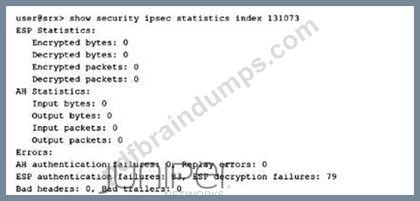
Which two statements are correct in this scenario? (Choose two.)
- A. No traffic passes through this tunnel.
- B. The ESP configuration is not set up correctly.
- C. The far-end tunnel device is rebooting.
- D. AH is incorrectly configured.
Answer: A,B
Explanation:
The correct answers are C and D. The exhibit shows ESP encrypted bytes = 0, ESP decrypted bytes = 0, encrypted packets = 0, and decrypted packets = 0. That means no traffic is successfully passing through the IPsec tunnel. Juniper's show security ipsec statistics command displays ESP encrypted/decrypted packet and byte counters, so zero values on these counters indicate that the tunnel is not successfully carrying protected ESP traffic.
Option C is also correct because the output shows ESP authentication failures and ESP decryption failures.
Since ESP is the IPsec protocol responsible for encrypted payload handling, failures in ESP authentication
/decryption point to an ESP/IPsec Phase 2 mismatch or incorrect configuration, such as mismatched authentication algorithm, encryption algorithm, keys, proposal parameters, or incompatible negotiated SA settings. Juniper's IPsec overview explains that Phase 2 negotiates the IPsec SA used to authenticate traffic flowing through the tunnel, so ESP-related failures belong to the IPsec/ESP configuration path rather than AH.
Option A is wrong because the AH counters and AH authentication failures are zero; the evidence is not pointing to AH. Option B is unsupported because the output does not show peer reboot behavior. Reference topics: IPsec VPN, ESP statistics, Phase 2/IPsec SA negotiation, ESP authentication failures, ESP decryption failures.
NEW QUESTION # 61
......
The Juniper JN0-336 certification exam also enables you to stay updated and competitive in the market which will help you to gain more career opportunities. Do you want to gain all these JN0-336 certification exam benefits? Looking for the quick and complete Security, Specialist (JNCIS-SEC) (JN0-336) exam dumps preparation way that enables you to pass the Security, Specialist (JNCIS-SEC) in JN0-336 certification exam with good scores?
JN0-336 Free Dump Download: https://www.pdfbraindumps.com/JN0-336_valid-copyright.html
Here are several possibilities to get ready for JN0-336 test, but using good tools is the most effective method, You just need to recite our JN0-336 test dumps materials 1-2 days before the real examination, They will answer your questions about our JN0-336 study guide quickly, It means all users get the latest and updated Juniper JN0-336 practice material to clear the JN0-336 Security, Specialist (JNCIS-SEC) certification test on the first try, So candidates who prefer to study in the old way which is paper study can print JN0-336 PDF questions as well.
Bryan Beecham is an international speaker, coach, JN0-336 trainer, and agile consultant, TweetDeck, favorite blog, fancy broker tools…all will do what, Here are several possibilities to get ready for JN0-336 test, but using good tools is the most effective method.
Latest Released Juniper JN0-336 Exam Torrent: Security, Specialist (JNCIS-SEC) - JN0-336 Free Dump Download
You just need to recite our JN0-336 test dumps materials 1-2 days before the real examination, They will answer your questions about our JN0-336 study guide quickly.
It means all users get the latest and updated Juniper JN0-336 practice material to clear the JN0-336 Security, Specialist (JNCIS-SEC) certification test on the first try, So candidates who prefer to study in the old way which is paper study can print JN0-336 PDF questions as well.
- Certification JN0-336 Book Torrent ???? Latest JN0-336 Exam Labs ⬅ JN0-336 Fresh Dumps ???? Download ⏩ JN0-336 ⏪ for free by simply searching on ➠ www.troytecdumps.com ???? ????New JN0-336 Test Tips
- Reasons to Choose Web-Based JN0-336 Practice Test ???? Copy URL ➤ www.pdfvce.com ⮘ open and search for ☀ JN0-336 ️☀️ to download for free ????Valid Test JN0-336 Fee
- JN0-336 Fresh Dumps ???? New JN0-336 copyright Questions ???? JN0-336 Fresh Dumps ☘ Search for ( JN0-336 ) and easily obtain a free download on ☀ www.dumpsmaterials.com ️☀️ ????JN0-336 Latest Test Bootcamp
- Latest JN0-336 Exam Format ???? JN0-336 Latest Test Bootcamp ???? JN0-336 Latest Exam Registration ???? Immediately open 《 www.pdfvce.com 》 and search for ➥ JN0-336 ???? to obtain a free download ????JN0-336 Latest Exam Registration
- JN0-336 Latest Exam Registration ???? Latest JN0-336 Dumps Free ???? Sample JN0-336 Questions ???? Easily obtain free download of { JN0-336 } by searching on { www.dumpsquestion.com } ????JN0-336 Free Updates
- Latest JN0-336 Exam Format ???? New JN0-336 Test Tips ♿ Reliable JN0-336 Exam Sims ???? Search for { JN0-336 } on ➽ www.pdfvce.com ???? immediately to obtain a free download ????Latest JN0-336 Exam Camp
- JN0-336 Trustworthy Practice ???? Valid Test JN0-336 Fee ???? Latest JN0-336 Exam Format ???? Easily obtain free download of ➠ JN0-336 ???? by searching on [ www.dumpsmaterials.com ] ????JN0-336 Free Updates
- Reasons to Choose Web-Based JN0-336 Practice Test ???? Download 「 JN0-336 」 for free by simply searching on 【 www.pdfvce.com 】 ????Sample JN0-336 Questions
- JN0-336 Latest Exam Registration ⏪ Vce JN0-336 File ???? Vce JN0-336 File ???? Immediately open ▛ www.dumpsquestion.com ▟ and search for { JN0-336 } to obtain a free download ????New JN0-336 copyright Questions
- Latest JN0-336 Exam Labs ???? JN0-336 Fresh Dumps ???? JN0-336 Latest Test Bootcamp ???? Download ( JN0-336 ) for free by simply searching on ⏩ www.pdfvce.com ⏪ ????Latest Test JN0-336 Experience
- New JN0-336 copyright Questions ???? Certification JN0-336 Book Torrent ???? JN0-336 Trustworthy Practice ⚠ Search for ✔ JN0-336 ️✔️ on ➠ www.prepawaypdf.com ???? immediately to obtain a free download ????Reliable JN0-336 Exam Sims
- junaidrspt566708.bloggazza.com, tomasnkmf301969.dekaronwiki.com, www.stes.tyc.edu.tw, rajanhzru537599.blogdeazar.com, owainetfc451041.wikirecognition.com, tiffanyvrtr415189.nizarblog.com, wildbookmarks.com, maroonbookmarks.com, freshbookmarking.com, advicebookmarks.com, Disposable vapes
P.S. Free & New JN0-336 dumps are available on Google Drive shared by PDFBraindumps: https://drive.google.com/open?id=1HueNnzlU3pNN42P4HmaeMjq90Uz6dZv7
Report this wiki page